“This is my invariable advice to people: Learn how to cook- try new recipes, learn from your mistakes, be fearless, and above all have fun!”
While we celebrated India’s birthday (our country has completed 64 years of Independence), the culinary world was celebrating the birthday of one of the most famous personalities where food is concerned- Julia Child. She is the most prominent figure in revolutionizing America’s culinary scene, bridging the gap between the home kitchen and the professional one. For Mrs. Child, mistakes were not the end of the world, just part of the game. I guess even the big boom in food blogging can be attributed to Julia Child and the admiration that one person had for Julia Child’s cookbook. Julie Powell’s Salon blog may be the first cook-through blog. And of course, the movie itself introduced a lot of people to the food blogging world.
We have a lot to thank Julia Child for. Mostly, gratitude is due for the inspiration she gave to us home cooks to follow our passion and not to give up on something we are passionate about. Julia Child began learning to cook when she was thirty-seven years old. That in itself should be a testimony to the fact : It’s never too late to follow your dreams!
Firstly, I want to thank everyone who wished me, continues to read me and also a big thanks is extended to those who left their feedback as to what they liked on the blog and what they would like to see more of. All suggestions are duly noted and I’ll try my best to implement them.
Now for the giveaway winner:
Anyway that means Louis, I will be sending Sarabeth’s Bakery Cookbook to you! Congratulations!
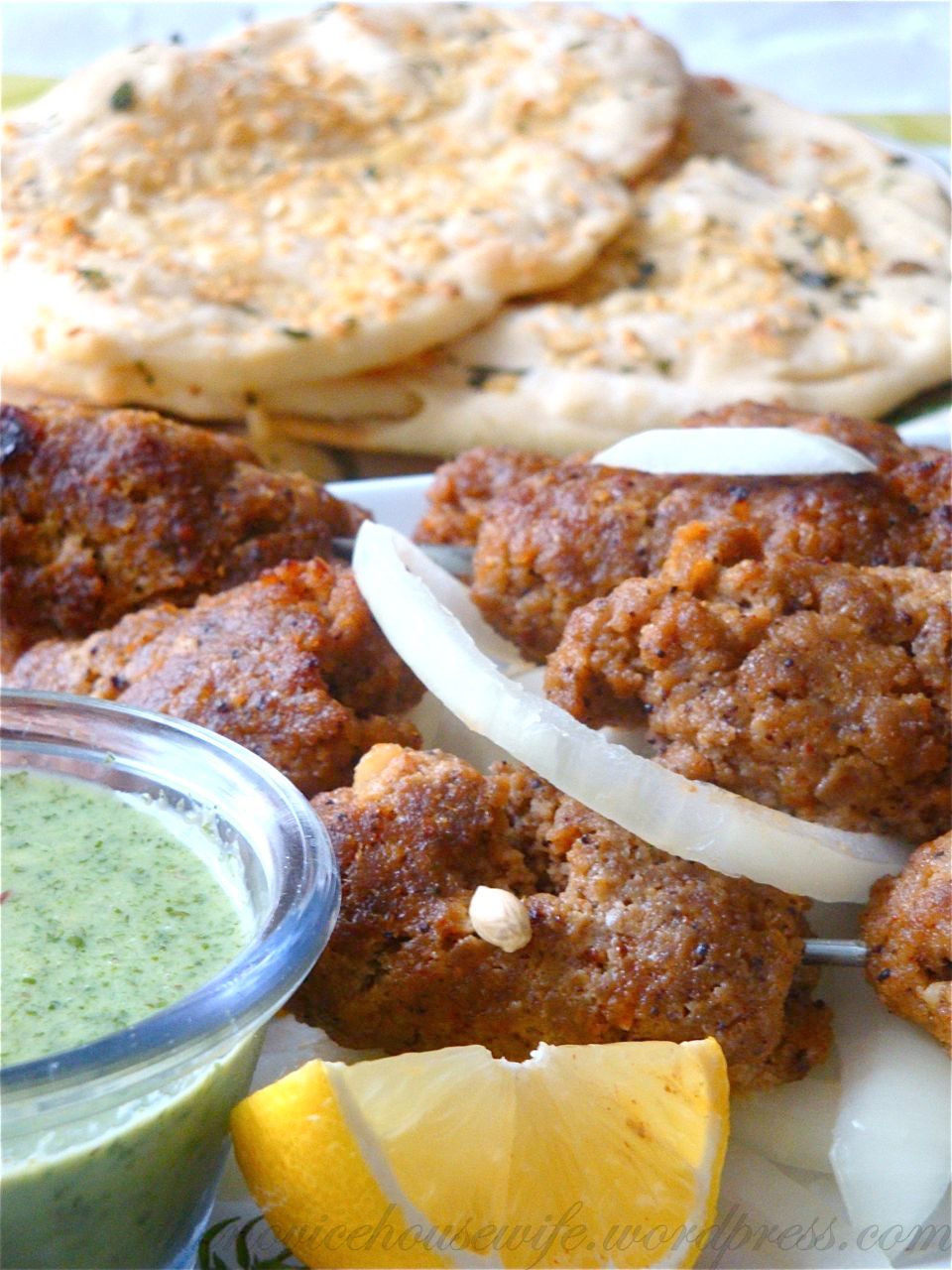
Leigh from Luv n Spoonsfuls mentioned in her comment that she would like to see more basic Indian dishes that are universally acclaimed. Keeping that in consideration, it was only befitting to celebrate Independence day and this week’s GMT with kebabs and naans– both popular Indian dishes in Indian restaurants everywhere. And though the method seems times consuming at first glance, it is pretty easy and straightforward to achieve results in both the recipes.
Mughlai cuisine is classified as the richest and most lavish cuisine of North India. It revolves around lamb preparations for which it is famous. Prepared with cream, luscious fruits, and almonds, and served with rich pulavs (preparations of rice), the gamut of lamb preparations can be described in one sentence: “A really superb North Indian cook can produce a different lamb dish for every day of the year.”
History, tradition, and religion have encouraged North Indian cooks to experiment with lamb dishes. Because of their Muslim backgrounds, Mughal kitchens could not use pork. The use of beef was also actively discouraged in a predominantly Hindu country. And, neither geography nor habit permitted the ready inclusion of fish or seafood in the diet. Although Mughlai cuisine came to include some excellent chicken dishes, they never compared in quality or scope with the supreme Mughlai culinary achievement, the inspired cooking of lamb. It was mandatory that the animal be slaughtered by cutting the jugular vein with a sharpened knife and while uttering the name of Allah. The meat produced from this type of slaughter, that is, by bleeding the animal to death, was called halal meat.
Kakori is a small village town on the outskirts of Lucknow, the capital city of the Indian state Uttar Pradesh. During the freedom struggle, it became well known for the famous ‘Kakori Case’ when a band of freedom fighters looted the train carrying the British Government Treasury money at this obscure place.
In the same period, of British rule, it was also customary in this region for the rich Rajas and Nawabs, to entertain senior British Officers and ply them with the best hospitality they could offer. And if it was the mango season , a ‘mango dinner’ was very much in order (dinner in a mango orchard, was followed by a variety of chilled mangoes served in great style).
At one such parties in Kakori, stung by the remark of a British Officer regarding the coarse texture of Seekh Kabab, the host, Nawab Syed Mohammad Haider Kazmi summoned his cooks the very next day and asked them to evolve a more refined variety of the Seekh Kebab. Ten days of incessant research and design efforts resulted in the now famous ‘Kakori Kebabs’ which was as far as perfection could go. The mince for the kebab was to be obtained from no other part but the ‘Raan ki Machhli’ (Tendon of the leg of mutton) and Rawaz or animal fat was replaced by khoya, black pepper replaced by white pepper and a brand new mix of powdered spices which still remains a closely guarded secret added to the perfect blend. And of course, the Nawab invited the same officer again and presented the new version of the Seekh Kebab and needless to say it met with great applause. Since then the Seekh Kebabs of Kakori became famous by word of mouth and even today, though cooked elsewhere, are known as ‘Kakori Kebabs’.
There are claims that the origin of these soft and delicate kebabs actually revolve around the toothless Nawab (king) of Kakori. He was old and toothless (some versions say he lost his teeth in a freak accident). He craved to eat meat, yet because of his condition he could not. The royal chefs were then called upon to make something especially for the king. After a lot of brainstorming, the kakori kebab came about.
Either ways, thank god for the whims and fancies of the aristocrats/rulers that reigned over India. Thanks to them, we are able to enjoy the goodness of melt in your mouth kebabs!
Another thing that the Mughals brought to indian cuisine was their flatbread Naan.
Naan is a flatbread that is a staple food in Southeast and Central Asia. It is especially common in India, Pakistan, Afghanistan, Iran, Uzbekistan, and surrounding regions. Because naan is popular in so many countries, it has a number of different spellings and pronunciations. In Turkic languages such as Uzbek and Uyghur, for example, naan is known as nan. In Burma, the bread is called nan bya. The Burmese variation is slightly softer and resembles pita bread more than other types of naan.
With leftover naan and kebabs you can make rolls. Slather a little mayo, mint chutney and ketchup on the naan. Put the kebabs and top with some onions and make a roll. You can keep it together by putting a toothpick in the center. They are delish!
You can also make Naan Pizza.
You can make this an even more complete meal by adding some dal makhani to the menu. And finishing it all off with some Mango Kulfi. Now that is a Nawabi (king size) meal!
As Julia Child would say in her up-the-scales signature signoff,
“Bon appétit!”
Makes 8 naans
Adapted from India: Cookbook
Ingredients
Directions
Serves 4
Ingredients
Directions
Can’t decide between a rich brownie and a classic cookie? This ultimate brookie recipe delivers…
Fresh mango pulp and a spicy kick from the jalapeños makes this refreshing and quick to make…
Homemade mushroom ravioli: a meatless pasta dinner. Homemade pasta dough stuffed with a creamy mushroom…
The perfect christmas tradition of making gingerbread cookies is complete with these spice loaded homemade…
Since the thanksgiving tablescape was such a hit on social media or more…
A one bowl chocolate cake layered with whipped salted caramel ganache. A great crowd pleaser.…